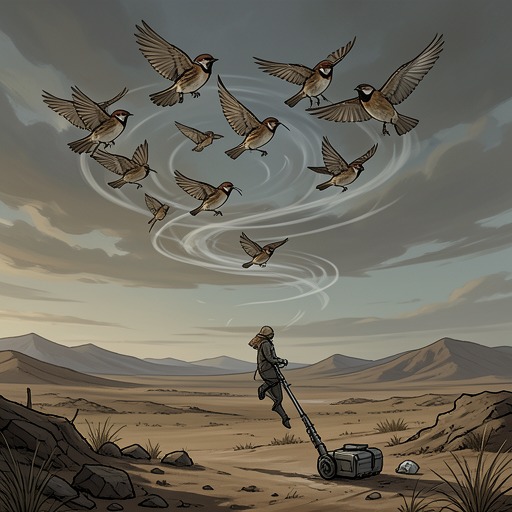
“The sparrows are flying again” written in blood
The Dark Half“The sparrows are flying again” written in blood is a repeated message left at murder scenes by George Stark. Its significance lies in how it joins apparently separate crimes to Thad Beaumont’s concealed past: police initially treat the words as withheld evidence, while their recurrence makes the phrase a threat and a sign that Stark’s violence is connected to Thad in ways the investigation cannot readily explain.
First Appearance and Withheld Evidence
At Frederick Clawson’s apartment in Washington, D.C., investigators found words written on the wall in the victim’s blood. Alan Pangborn told Thad and Liz Beaumont that the Washington police were withholding this physical evidence, a common practice meant to distinguish genuine knowledge from false confessions. He disclosed the phrase, “The sparrows are flying again,” and asked whether it meant anything to them. Liz answered no; Thad also denied recognizing it, though only after a momentary hesitation. The exchange gives the message two audiences at once: the police, who treat it as a controlled clue, and Thad, whose reaction hints that its meaning reaches beyond what he is prepared to say.
The phrase appears amid an investigation already focused on Thad. Homer Gamache had been killed between one and three in the morning on June 1 with his own prosthetic arm, and his truck was found at a Connecticut rest stop near the New York border. Several fingerprints on the truck belonged to the perpetrator; one had been left in blood on the rearview mirror. The prints matched Thad’s service record, making him a murder suspect even as the circumstances raised questions about the apparent evidence. Thad challenged the reliability of the prints and pointed out that Maine required six perfect comparisons for a fingerprint to be admissible. Against that forensic uncertainty, the phrase at Clawson’s apartment offers another kind of clue: not a conventional identification, but a message whose connection to Thad remains unspoken.
The Message as a Link Between Crimes
Stark writes the phrase after killing Miriam Cowley. He uses her blood to print on the wall above her, then leaves the apartment. The message therefore first functions as part of Stark’s own pattern of communication: it is not simply a clue the police discover, but writing Stark deliberately places at a crime scene.
The phrase returns at Rick Cowley’s apartment after an explosion kills two communications technicians who had come to work on the phones. A note is pinned to the forehead of one victim and reads, “THE SPARROWS ARE FLYING AGAIN.” A second note, attached to the other technician, says, “MORE FOOL’S STUFFING. TELL THAD.” The repetition turns the words into an unmistakable signal addressed beyond the immediate victims. The added instruction names Thad as the person who must receive the message, connecting the scene’s violence directly to him.
These appearances also shift the phrase’s status. At Clawson’s apartment, it is a piece of evidence the police deliberately keep from public view before Pangborn shares it with the Beaumonts. At Rick Cowley’s apartment, it is delivered as a message to Thad, with the repeated wording reinforced by a second note. What had seemed to be a cryptic signature now has a clear target, even though its full meaning is still unresolved.
Thad’s Past and Stark’s Literary Double
The phrase gains force from the history of Thad’s pen name. In an interview, Thad explains that creating George Stark helped him escape writer’s block by giving his work an identity separate from his own. He chose the name in part after learning of crime writer Donald E. Westlake’s Richard Stark pseudonym, associated with novels about the professional thief Parker. Thad recalls Westlake’s account of writing under his real name on sunny days and as Stark on rainy ones, and associates that division with his own difficult years from 1973 to early 1975.
The novels published under Thad’s pseudonym feature Alexis Machine, a character described as a relentless, single-minded criminal. Their fiction establishes a disturbing parallel with the crimes now being investigated: the violent world created under Stark’s name no longer stays safely inside books. Dodie Eberhart, who reads crime fiction closely and regards George Stark as one of its best practitioners, recognizes the identity through its works and its readership; for her, the name belongs to a distinctive body of hard-edged crime novels. The blood-written phrase draws that literary identity into the real murder investigation, where written words become both evidence and a means of reaching Thad.
Thad himself had already proposed a hypothetical explanation for the fingerprints: an identical twin could have hosted his party while Thad committed the crimes, then taken up Thad’s life again. He presents the scenario as an absurd reconstruction of what the police might imagine, not as a confession. Its relevance to the recurring message is structural rather than evidentiary: the story repeatedly unsettles the boundary between one identity and another, just as the phrase makes Thad’s private history seem to intrude on public crime scenes.
Repetition and the Limits of Explanation
The message’s recurrence matters because it survives the investigators’ efforts to classify the murders through ordinary evidence. The bloody fingerprint on Homer Gamache’s truck and the words at Clawson’s apartment belong to different kinds of evidence: one appears to identify a person; the other links scenes through a repeated phrase. Thad’s questions about fingerprint comparisons expose uncertainty in the first, while the hidden status of the Clawson message shows how the police regulate access to the second. Neither immediately explains how the crimes connect to Thad or to the name George Stark.
Later, a report from Fuzzy Martin adds a further unsettling detail to the case: a message he saw read “HIGH-TONED SON OF A BITCH.” Pangborn tells himself that the report proves nothing supernatural, but he cannot keep that dismissal intact. He thinks of the voice-print and fingerprint evidence and of hundreds of sparrows crashing into the windows of Bergenfield County Hospital, then shivers violently. The scene does not establish a simple, rational explanation for the bloody phrase; instead, it places the message within a pattern whose clues increasingly strain conventional interpretation.
As a recurring written mark, “The sparrows are flying again” joins authorship, identity, and violence without reducing them to a single solved clue. Stark’s words turn the crime scene into a form of communication, while their repetition makes each appearance revise the meaning of the last. The phrase’s movement from withheld evidence to an explicit warning addressed to Thad mirrors the novel’s larger disturbance: what was created under a separate name presses into the life of the writer who tried to keep that name apart from his own.